By SevenDays · Updated
Leggi in italiano →How Codex happened: the road from cloud to desktop
How OpenAI Codex happened: its research origins, the difficult cloud launch, the local restart and the desktop app that merged into ChatGPT.
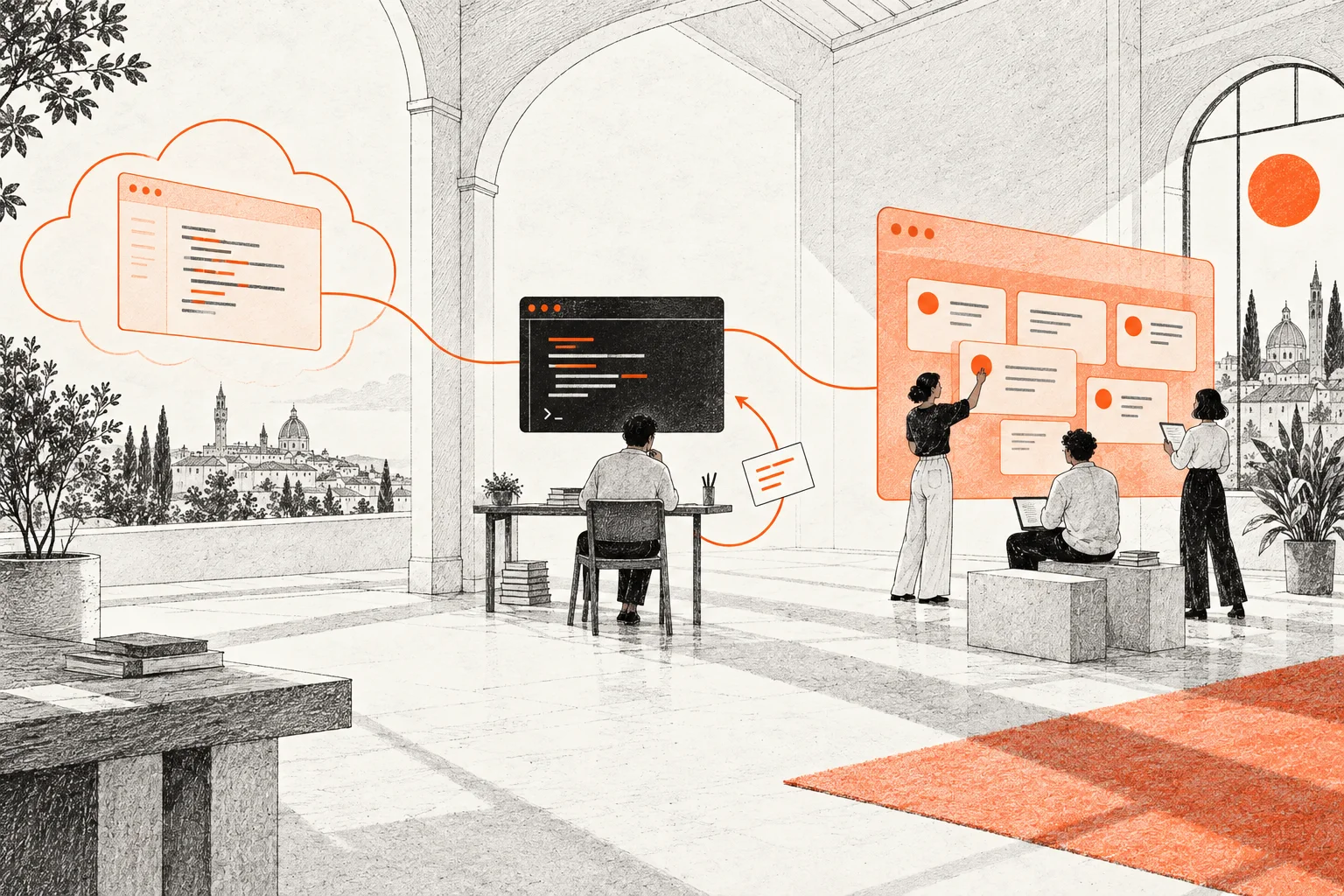
The answer in brief
- Codex evolves from a code-generating model in 2021 into software agents in 2025.
- The product develops across cloud, terminal and editor before the February 2026 app.
- In July 2026, Codex technology becomes part of ChatGPT’s new desktop experience.
Codex became central to OpenAI through successive restarts: from cloud to local work, then to a desktop app and ChatGPT. Its history crosses three different challenges: enabling the model to act, finding an environment where people can use it and building an interface to follow its work.
Our starting point is How Codex Happened by Dan Shipper, published by Every. We revisit essential milestones from that account alongside OpenAI’s original announcements. The sequence is chronological; dates refer to the versions released at the time.
1. Codex begins before the agent and restarts with reasoning models
In 2021, Codex turns requests into code
The name predates today’s product. On August 10, 2021, OpenAI introduces Codex, a GPT-3 descendant trained partly on public code and the model behind the original GitHub Copilot. Its job is to turn natural-language instructions into code. (OpenAI, August 10, 2021).
This is the opening chapter: bringing what a person wants to build closer to instructions a computer can execute. An agent working on a whole project comes later.
In 2024, reasoning opens another possibility
On September 12, 2024, OpenAI announces o1-preview. Its stated distinction is spending time on a problem before answering: the model learns to try strategies and recognize mistakes. Coding is among the domains highlighted at launch. (OpenAI, September 12, 2024).
That distinction helps explain what follows. Generating a solution and completing an assignment are different objectives: the latter also requires tools, execution and the ability to correct course.
Research and product converge in the Codex team
Shipper describes Thibault Sottiaux accelerating internal research, Alexander Embiricos exploring product form and Mia Glaese connecting research with use. Their initiatives converge in the Codex team. (Every, accessed October 16, 2026).
2. The first cloud launch struggles and Codex returns to the user’s computer
In May 2025, OpenAI introduces a cloud agent
On May 16, 2025, Codex Cloud launches with codex-1, an o3 variant specialized for software engineering. A user assigns a task; the agent reads the repository, changes files and runs checks in an isolated environment. It returns changes for review. The launch notes a limitation: users cannot yet redirect the agent during execution. (OpenAI, May 16, 2025).
Every reports a launch without sustained adoption: setup is difficult and the models are not ready. (Shipper, accessed October 16, 2026).
The terminal provides a route to restart
A local route already exists: Codex CLI, the command-line interface released on April 16, 2025. That date is one month before the cloud launch. (OpenAI, April 16, 2025 update).
Sottiaux brings the project back to users’ computers and rebuilds the agent in Rust. (Every, accessed October 16, 2026).
September 15 brings GPT-5-Codex, trained for real software engineering. OpenAI makes it available across terminal, editor and cloud. The announcement documents a product connecting local and remote environments, with an extension for VS Code and Cursor. (OpenAI, September 15, 2025).
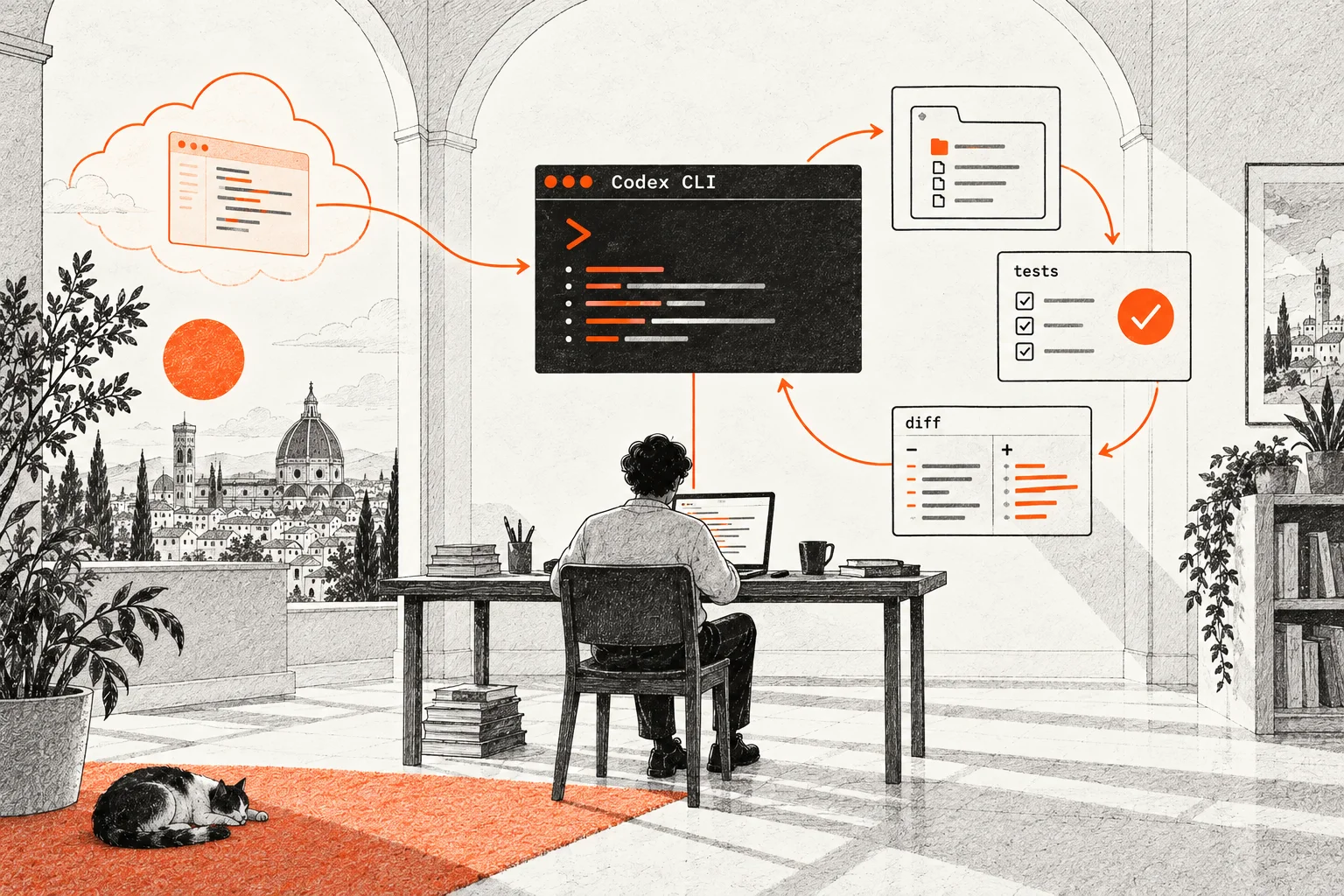
Local work provides the route to restart. SevenDays conceptual illustration, generated with AI.
By late 2025, the models tackle longer assignments
On November 19, GPT-5.1-Codex-Max introduces training to work across multiple context windows through compaction. On December 18, GPT-5.2-Codex improves large changes, migrations and extended sessions. (OpenAI, November 19, 2025; OpenAI, December 18, 2025).
Compaction preserves useful context as a session continues. That matters for an agent: the work needs to continue across many files and attempts.
3. The app organizes agents and brings Codex into ChatGPT
The team bets on an app without a built-in editor
Andrew Ambrosino joins the app effort: the team initially leaves out an integrated editor, despite internal doubts. (Every, accessed October 16, 2026).
On February 2, 2026, OpenAI launches the macOS app. Tasks live in project-based conversations; agents can work on separate copies of the code and users can review changes. The terminal remains, alongside a space designed for following multiple assignments. (OpenAI, February 2, 2026).
Codex contributes to its own development and moves beyond code
Three days later, on February 5, OpenAI introduces GPT-5.3-Codex. The company says it used early versions to debug training, manage deployment and interpret evaluations. The model combines coding, reasoning and professional knowledge capabilities. (OpenAI, February 5, 2026).
On June 2, OpenAI reports more than 5 million weekly active users, with knowledge workers representing roughly 20%. Described uses include reports, spreadsheets, presentations and research. These are figures reported by the provider on that date. (OpenAI, June 2, 2026).
In July 2026, the story meets ChatGPT
On July 9, OpenAI announces that the Codex app is merging into the new ChatGPT desktop app and introduces ChatGPT Work, built partly on Codex technology. Codex retains its dedicated space for software development. (OpenAI, July 9, 2026).
Shipper’s account eventually returns to the cloud: continuing work with the laptop closed. (Every, accessed October 16, 2026).
Our interpretation: each restart changes the product’s form
For SevenDays, this history turns on the relationship between capability and interface. The documented sequence moves from code generation to executable assignments, then to managing multiple agents. The product changes as the work a model can sustain changes. This is our interpretation of the chronology, rather than a conclusion attributed to its protagonists.
Main sources: Dan Shipper, Every, and the OpenAI announcements linked throughout. Accessed October 16, 2026. Illustrations represent concepts and stages of the story; they are not portraits of the protagonists or product screenshots.